The Dartmoor of The Hound of the Baskervilles

When Sir Charles Baskerville dies of fright near a legend of a spectral hound, Sherlock Holmes sends Dr Watson to guard the heir on the lonely wastes of Dartmoor while he works unseen. Doyle's most famous case maps a real and forbidding landscape: the Baker Street opening, Baskerville Hall on the moor, the treacherous Grimpen Mire, and the fog-bound heath across which the great hound comes.

Author
Arthur Conan Doyle, 1902
Places
5

Open the interactive map →

The case opens0% in
Holmes

221B Baker Street

The case opens
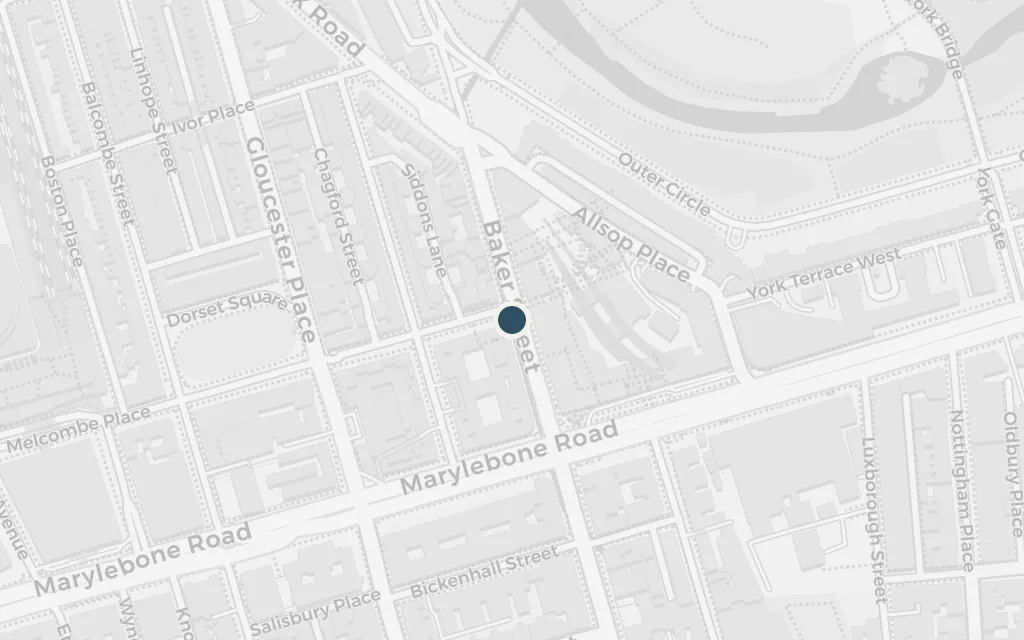
Map of 221B Baker Street today
Dartmoor today

At Baker Street, Dr Mortimer lays before Holmes the legend of the Baskerville hound and the strange death of Sir Charles, and Holmes reads a whole history from a forgotten walking-stick. Doyle begins in the familiar London rooms before dispatching Watson to the moor, keeping the great detective offstage to sharpen the suspense of the wild country to come.

The opening chapters

inspired byThe case opens at Holmes and Watson's rooms at 221B Baker Street in London, the fictional address on the real street; sited there, outside the Dartmoor setting.
Open in Google Maps ↗Street View ↗

The moor25% in
Sir Henry

Baskerville Hall

The moor

Map of Baskerville Hall today
Dartmoor today

Watson escorts the new heir, the sturdy Sir Henry Baskerville, to the grim old hall set amid the Dartmoor wastes, where an escaped convict roams and every neighbour hides something. Doyle steeps the house in dread, the baying heard across the moor at night and the ancient curse pressing on a man who refuses to be frightened from his own home.

The Baskerville Hall chapters

inspired byBaskerville Hall, the cursed family seat on Dartmoor, is a fictional house drawn from the great houses of the Devon moor; sited there.

Open in Google Maps ↗Street View ↗

The bog50% in
Watson

The Grimpen Mire

The bog

Map of The Grimpen Mire today
Dartmoor today

Out on the moor lies the Great Grimpen Mire, a green, sucking bog that only a hidden path crosses, and into which the unwary vanish without trace. Doyle makes the mire the story's most sinister feature, a natural trap that conceals both the villain's secret lair and, in the end, the means of his own destruction.

The moor chapters

inspired byThe deadly Grimpen Mire, a bog that swallows ponies and men, is drawn from the real treacherous mires of Dartmoor such as Fox Tor Mire; sited on the moor.

Open in Google Maps ↗Street View ↗

The naturalist75% in
Stapleton

Merripit House

The naturalist

Map of Merripit House today
Dartmoor today

At lonely Merripit House lives the mild naturalist Stapleton, who chases butterflies across the moor and hides, behind his affable manner, both a false marriage and a murderous design on the Baskerville fortune. Doyle plants his villain in plain sight, the outwardly harmless collector who has bred and starved a real hound to play the family ghost.

The Merripit chapters

inferredMerripit House, the moorland home of the butterfly-collecting naturalist Stapleton, is drawn from the isolated dwellings of Dartmoor; sited on the moor.

Open in Google Maps ↗Street View ↗

The climax100% in
Holmes

The hound on the moor

The climax

Map of The hound on the moor today
Dartmoor today

In the fog a monstrous hound, its muzzle daubed with phosphorus to glow like a fiend, comes bounding after Sir Henry, and Holmes, waiting unseen, shoots it dead and unmasks Stapleton, who flees to his death in the mire. Doyle ends by dissolving the supernatural terror into a coldly rational crime, the ghostly hound revealed as paint, hunger and human greed.

The final chapters

inspired byThe climax, in which the phosphor-painted hound is loosed through the fog and Holmes reveals the human hand behind the legend, is set on the open moor; sited in the setting.

Open in Google Maps ↗Street View ↗